
Profile
Loughborough: The Town That Already Knows How Good It Is
It gets bypassed. It gets mislabelled. People glance at it from the M1 and file it somewhere between “not Leicester” and “not Nottingham.” They’re missing the point entirely. Here’s the case for a town that has been quietly extraordinary for eight centuries — and couldn’t care less whether you’ve noticed.
Let me tell you something about Loughborough that most people who have never actually spent time here will struggle to believe. This town — this warm, unpretentious, genuinely remarkable market town on the edge of Charnwood Forest — has been getting on with being brilliant since before anyone thought to write it down. It doesn’t shout about itself. It doesn’t perform. It has bells in the towers of Westminster Abbey and Yale University, a railway that makes grown adults weep with something approaching joy, and one of the finest Victorian parks in the East Midlands — and it wears all of it with the kind of easy confidence that you only get from having been here a very long time.
I live here. I know this town in the way you only know a place when you’ve walked it in all weathers, eaten in its restaurants when they were quiet, watched its streets fill up for the November Fair, and stood at the top of the Carillon Tower on a clear morning wondering why more people aren’t doing exactly this. Loughborough doesn’t need me to defend it. But I’m going to anyway.
Eight Hundred Years and Counting
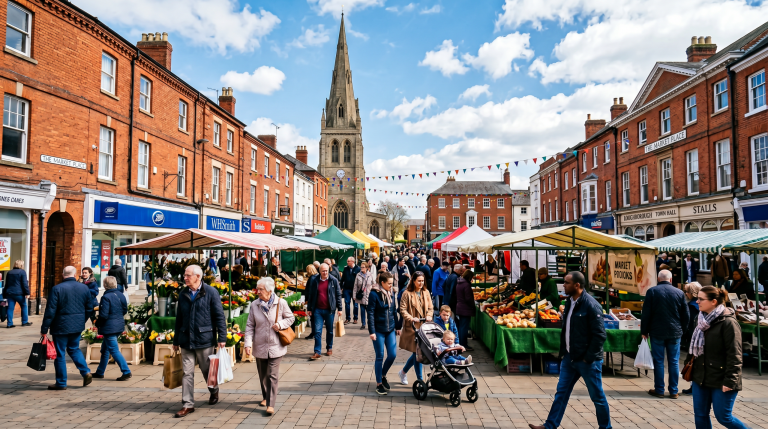
Start with the market, because everything in Loughborough starts with the market. King Henry III granted the town its market charter in 1221 — and every Thursday and Saturday since, traders have been setting up their stalls in the Market Place at the heart of town. That is not a heritage story. That is a living institution. The market was named Best Outdoor Market in Britain at the National Market Traders’ Federation Awards, and anyone who has spent a Saturday morning browsing through its produce stalls, clothing sellers, handmade crafts and fresh-cooked street food will not be remotely surprised.
The town itself is older still. It began as a Saxon settlement, appears in the Domesday Book of 1086 with a population of perhaps two hundred souls, and has been growing — industrially, academically, culturally — ever since. From the Tudor wool merchants who funded a grammar school that still stands, to the Victorian engineers who built an empire of manufacturing in the Charnwood valleys, Loughborough has always been a town that makes things. It has just never been particularly interested in making a fuss about it.
The Bells That Ring Around the World
If Loughborough is known for one thing beyond its borders, it is bells. John Taylor & Co, operating from their Victorian-era foundry on Freehold Street, is the last working bell foundry in England — and one of the finest in the world. Bells cast here hang in St Paul’s Cathedral. In York Minster. In Truro and Newcastle and Westminster Abbey. In Yale University. In the Australian National Carillon in Canberra. The history of this foundry runs back to the 1300s, and it has spent the centuries since ringing out across every continent on earth.
You can visit. You can book a tour, walk through the Victorian factory buildings, watch molten bronze being poured into moulds, and have a go at ringing bells so large they make your bones resonate. It is one of those experiences that is difficult to describe without sounding hyperbolic, so I will simply say this: there is nowhere else in Britain quite like it.
And then there is the Loughborough Carillon in Queen’s Park — a 46-metre neo-Baroque tower built as a memorial to the town’s fallen in the First World War, inspired by the famous belfries of Flanders where so many of them died. It holds 47 Taylor bells and is Grade II listed. On summer Thursdays and Sundays the bells ring out across the rooftops for a full hour. It is, if you stop to think about what you are hearing and why, one of the most moving sounds in Leicestershire.
A Railway That Stops Time
The Great Central Railway runs for 8.25 miles from Loughborough Central Station south toward Leicester North, calling at three lovingly restored Victorian stations along the way. This is the only double-track mainline heritage railway in Britain — which means it is the only place in the country where you can watch two full-size steam locomotives pass each other at speed, exactly as they would have done in the golden age of rail. The engines date from the early decades of the twentieth century. The carriages are British Mark I coaches from the 1950s. Loughborough Central station itself, with its glass canopy and Victorian ironwork, is so beautifully preserved it feels less like a day out and more like a displacement in time.
It runs every weekend all year, and on weekdays through the summer holidays. Families love it. Railway enthusiasts make pilgrimages from across Europe for it. And people who didn’t think they were particularly interested in trains discover, somewhere around the third tunnel and the second plume of steam, that they were wrong.
Queen’s Park and the Town That Breathes
Right in the centre of Loughborough, within easy walking distance of the market and the high street, Queen’s Park is the kind of green space that makes you appreciate living somewhere that hasn’t forgotten what a town is supposed to feel like. Opened in 1899 to mark Queen Victoria’s Diamond Jubilee, the park has formal flowerbeds, a bandstand with a full programme of summer concerts, an aviary, sculptures from Loughborough University’s art students, and a children’s play area that actually gets used.
The Charnwood Museum, housed in the former Victorian swimming baths at the park’s edge, is Loughborough’s most ambitious cultural space — and it earns that description. Where else can you stand beneath a full-size replica plesiosaur excavated from nearby Barrow upon Soar, alongside Bronze Age pottery, an Anglo-Saxon gold sword pommel, and a ceiling-mounted aircraft built by the Auster aviation company just outside town? It also houses the story of Ladybird Books, the much-loved children’s publishing imprint born in Loughborough that shaped the reading lives of generations of British children. Free entry. No fuss. Exactly what a local museum should be.
Art Deco, All Saints, and Architecture Worth Looking Up
Loughborough went through a burst of confident construction in the 1930s, and the legacy is visible all over the town centre if you remember to look up. The Market Street and Market Place elevations carry beautiful Art Deco facades above their chain-store ground floors. The former Odeon cinema on Baxter Gate — now a bingo hall, which feels apt — is clad in glazed faience tiles and curves with period swagger. The current Odeon on Cattle Market, Grade II listed since 1936, has a tower of geometric ridges that belongs on a film set.
And then there is All Saints’ Parish Church — a fourteenth and fifteenth-century wool church made grand by the wealth of Loughborough’s medieval textile trade, and one of the largest parish churches in Leicestershire. The tracery in the chancel windows alone is worth the visit. The Old Rectory next door contains fragments of the thirteenth century, and a small museum that opens on summer Saturdays for those who want to go deeper into what this town was before it became what it is now.
Charnwood on the Doorstep
What strikes visitors — really strikes them, in the way that changes their perception of a place — is how quickly Loughborough gives way to extraordinary countryside. Beacon Hill Country Park is fifteen minutes from the town centre: 330 acres of heathland and ancient igneous rock around a summit that once held a Bronze Age hill fort, with views stretching to the Peak District in the north and Lincoln Cathedral on a clear day. The Outwoods, an ancient Site of Special Scientific Interest southwest of town, offers 110 acres of centuries-old oaks and birches, with pre-Cambrian rock outcrops and, in April and May, a bluebell season that makes the short drive entirely worthwhile.
This is Charnwood Forest: an ancient, volcanic landscape of extraordinary character sitting immediately outside one of the East Midlands’ most liveable towns. It is not a well-kept secret — locals know it and use it constantly — but it remains, somehow, underappreciated by the wider world.
The University and the Energy It Brings
Loughborough University is, by most measures, one of the most successful universities in Britain. It consistently ranks at or near the top for student experience, its sports facilities are the envy of institutions three times its size, and its alumni list includes Olympic champions, world-record holders, and figures who have shaped British engineering and design. One in four people in Loughborough is a student, which means the town carries a constant current of energy — in its cafés, its bars, its independent restaurants, its evening economy.
This is not a university that sits apart from its town. It has grown into Loughborough’s identity in the way that great academic institutions do when they are properly embedded in a place. The result is a town with a younger demographic than its neighbours, a food and social scene that punches above its weight, and a restless creative energy that coexists comfortably with the market town that has been here since the Plantagenets.
The Town That Already Knows
I said at the beginning that Loughborough doesn’t perform. That is true. There is no visitor campaign built around a single landmark. There is no single story the town has decided to tell about itself. Instead there is a bell foundry that has been ringing out across the world for seven centuries, a steam railway that makes you forget what decade you’re in, a park with a war memorial that stops you in your tracks, a market that has never stopped trading, and countryside of such quality that people who discover it for the first time are genuinely annoyed nobody mentioned it sooner.
Loughborough does not need your approval. But if you come — really come, walk the streets, ride the railway, stand at the top of the Carillon Tower, eat well, breathe the Charnwood air — you will understand why the people who live here are not particularly interested in leaving.
It has been here a very long time. It will be here long after the bypass traffic has moved on. And it has never once needed anyone to speed up and notice.
Loughborough is home to hundreds of brilliant independent businesses — the kind that make a town worth living in. Discover them here.

Read more


Local Attractions
Map
Sorry, no records were found. Please adjust your search criteria and try again.
Sorry, unable to load the Maps API.

