
Profile
Hinckley: The Town at the Centre of Everything
It sits at the very heart of England and most people drive straight through it. They take the A5 to somewhere else, glance at the road signs, and form an opinion that costs them nothing and tells them less. Here’s why they’re wrong.
There is a joke — not a particularly funny one — that Hinckley is what you pass through on the way between Leicester and Coventry. A junction on the map. A services stop with ambitions. The kind of place that other places use as a reference point rather than a destination in itself. I have heard it said and I have always thought the same thing: the people who say that have never actually stopped.
Hinckley is, to be precise about it, the town at the geographical centre of England. Not metaphorically. Not approximately. It sits at the point where the East Midlands meets the West Midlands, where Leicestershire rubs shoulders with Warwickshire, where the ancient Roman road of Watling Street — now the A5 — has been moving people and ideas and goods through this landscape for two thousand years. The Romans knew what they were doing when they built through here. So did the wool merchants, the stocking framers, the canal engineers, the Victorian railway builders, and the motorcycle designers who followed them. This has always been a town where things happen and things get made. It just never developed the habit of making a great noise about it.
A Market Town for Seven Centuries
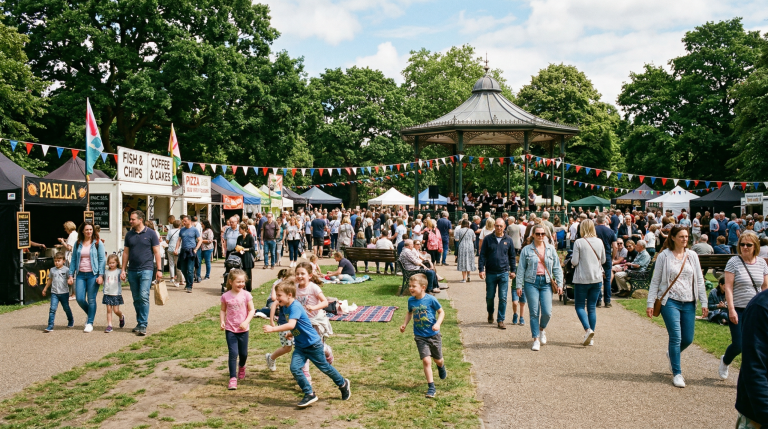
Start where Hinckley has always started: the market. The first record of a market here dates to 1311, and it has been running on Castle Street and the surrounding streets ever since — 700 years of traders setting up stalls, buyers driving in from surrounding villages, the ordinary commerce of a community going about its business in the same place, generation after generation. The market has won national awards and still draws people from across the borough on market days, offering everything from fresh produce and plants to clothing, street food and the kind of miscellaneous stalls that make market shopping worth doing in the first place.
The town centre has been significantly transformed in recent years. The pedestrianised heart — running through the Market Place, Castle Street and Regent Street — carries the usual mix of high-street names and independent shops, with the Britannia Centre and Hansom Court offering covered retail options alongside The Crescent, which brings together a bus station, supermarket, independent traders and a cinema in one of the better examples of modern town centre development in the East Midlands. The annual events calendar gives the centre a pulse year-round: St George’s Day celebrations, Feast Hinckley, the Tin Hat Fun Fair, a Soapbox Derby, and one of the county’s most popular Christmas lights switch-ons. A town that knows how to give its residents a reason to come out.
The Cradle of the Hosiery Industry
There is a phrase that crops up in Hinckley’s history again and again, and it deserves attention: the cradle of the hosiery industry. It is not a marketing invention. It is simply what this town was. In 1640, the Reverend William Lee’s stocking frame — the revolutionary knitting device that changed textile production in Britain forever — arrived in Hinckley, and within decades the surrounding area had become the centre of one of England’s most significant cottage industries. Families worked frames in their homes. Villages across Charnwood and the surrounding parishes supplied the mills. By the Victorian era, steam-powered hosiery factories were employing thousands across the town, and Hinckley’s name was synonymous with the socks, stockings and knitwear that clothed a nation.
That industry declined, as industries do. But the physical evidence of it is still threaded through the fabric of the town — in the distinctive frameworkers’ cottages with their wide upper-storey windows designed to let in maximum light for the frame work, in the buildings that once housed the mills, and in the Ashby Canal that was constructed in 1804 specifically to carry Hinckley’s textile goods to the wider Midlands canal network and beyond. The Ashby Canal — the longest contour canal in England — still runs through the town today, now a leisure waterway of considerable beauty, popular with narrowboaters and walkers alike.
The Cab That Changed Cities
Not many market towns can claim to have invented the defining urban vehicle of the nineteenth century. Hinckley can. In 1834, an architect named Joseph Hansom arrived in the town and set about designing a new kind of horse-drawn carriage — one that combined speed with stability, engineered with a low centre of gravity to prevent the overturning that had made earlier cabs so dangerous. The first Hansom Safety Cab travelled down Coventry Road in Hinckley in 1835. Within a decade, versions of it were on every major street in London, New York, Paris and Vienna — the Victorian equivalent of the black cab, so ubiquitous that Arthur Conan Doyle put Sherlock Holmes in one as a matter of course.
Hansom Court, one of the town’s shopping areas on Stockwell Head, still carries his name. It is a modest tribute to a man whose invention transformed the daily life of cities on four continents, and it is exactly the kind of quietly understated acknowledgement that suits Hinckley perfectly. The town doesn’t need a monument. It just carries the name forward and gets on with things.
Triumph: Born in Britain, Based in Hinckley
If the Hansom Cab is Hinckley’s Victorian claim on the world, then Triumph Motorcycles is its contemporary one. The global headquarters of one of the most iconic motorcycle brands on earth sits on Jacknell Road at the edge of town — a sprawling, modern facility where every Triumph is conceived, prototyped, designed and tested before production. The company built its Hinckley factory in 1988, began producing bikes in 1991, and has grown from a bold revival into a genuinely world-class manufacturer. In 2024, the one-millionth Hinckley-built Triumph rolled off the production line — a milestone that would be celebrated loudly in most towns, and which Hinckley acknowledged with characteristic composure.
Triumph makes the Bonneville, the Tiger, the Trident, the Rocket 3 — bikes that are ridden in every country on the planet, that win awards year after year, that carry the words Made in England in a way that feels genuinely earned rather than nostalgic. Factory tours are available and they are, for anyone with even a passing interest in engineering or design, a remarkable experience. There is something genuinely stirring about watching one of the world’s great motorcycle brands being built a few miles from a medieval market town in the East Midlands.
St Mary’s and Seven Centuries of Stone
At the centre of Hinckley — quite literally at its heart, as it has been for seven centuries — stands the Parish Church of St Mary the Virgin. The oldest parts of the building date to the thirteenth century, with significant additions in the fourteenth, fifteenth and sixteenth. The spire was added in the eighteenth century and the whole structure carries that particular quality of English parish churches that have absorbed the additions of every era without losing coherence: a building that reads as ancient without being frozen in any single moment of the past.
The churchyard contains a grave of local legend — that of Richard Smith, a young saddler murdered in the Market Place in 1727, whose headstone is said to bleed on the anniversary of his death, every 12th of April. Whether you believe the folk tale or not, it speaks to something true about small English market towns: they carry their stories carefully, they remember their people, and they pass both on with a degree of relish.
Hollycroft Park and the Green Side of Town
Hinckley is, like all of the best English market towns, greener than it first appears. Hollycroft Park — donated to the people of the town by the local Atkins family in 1934 — is a Green Flag-awarded park offering tennis courts, a bowling green, a golf course, beautifully maintained gardens, and a bandstand that hosts some of the town’s biggest outdoor events, including Worldfest and the summer Proms concerts. It is the kind of park that rewards regular use: the sort of place where you go for an hour and stay for the afternoon.
Beyond the town’s own parks, the surrounding countryside offers some of the finest walking and cycling in the Midlands. Bosworth Battlefield — where Richard III met his end in 1485 in one of the most consequential battles in English history — is just a few miles north, at Sutton Cheney, and the site visitor centre brings that dramatic afternoon in August to life with real skill. Twycross Zoo, one of the UK’s leading animal conservation centres and home to the world’s largest collection of great apes outside Africa, lies just up the A444. Mallory Park Racing Circuit, which has been at the centre of British motorsport for decades, is on the doorstep to the north.
This is the thing that tends to surprise people: Hinckley does not exist in isolation. It sits at the intersection of some of the most historically significant and naturally beautiful countryside in the English Midlands, and it gives you immediate, easy access to all of it.
The Town That Made Things
There is a pattern in Hinckley’s history that repeats across the centuries. Something arrives — a technology, an idea, an inventor, a manufacturer — takes root in this town at the centre of England, and quietly changes the world. The stocking frame transforms the textile industry of a nation. A prototype safety cab tests its wheels on Coventry Road and within a generation is on every street in London and New York. An engineer builds a motorcycle factory on the edge of town and thirty years later the millionth bike rolls out of the gates.
Hinckley is not loud about any of this. It does not have the critical mass of a Leicester or the university profile of a Loughborough. What it has is something rarer: a genuine industrial identity running all the way from the medieval market through the hosiery cottage workers to the engineers on Jacknell Road today — a continuous thread of making things, doing things, contributing to the wider world in ways that rarely get the recognition they deserve.
Come and find that thread. Walk the market. Ride the canal towpath. Visit the Triumph factory and watch a British icon being built. Sit in the churchyard at St Mary’s and read the stones. Hinckley has been here for seven centuries and it is, by almost every measure, more interesting than the road signs suggest.
It was waiting for you to stop and look properly. Now you know.
Hinckley is home to hundreds of brilliant independent businesses — the people and places that make this town worth living in. Discover them.
Local Independent Business
Read more
Local Attractions
Map
Sorry, no records were found. Please adjust your search criteria and try again.
Sorry, unable to load the Maps API.

